IDLIntellectual Demand Laboratory

Reading Room Record · IDL-IH-007

Research designation: Sanctum Terraform

The AI Homestead

How Artificial Intelligence, Robotics, Energy, and Regenerative Design Are Creating the Living House

A field investigation into the home as an adaptive junction of shelter, energy, water, cultivation, fabrication, intelligence, and human care.

Document stateForthcoming publicationRelease0.1
Pre-order on Amazon ↗
Research programIntelligent Habitats
Layer classificationProbable Foundational Infrastructure
Layer statusEmerging
Public stateRelease 0.1 forthcoming
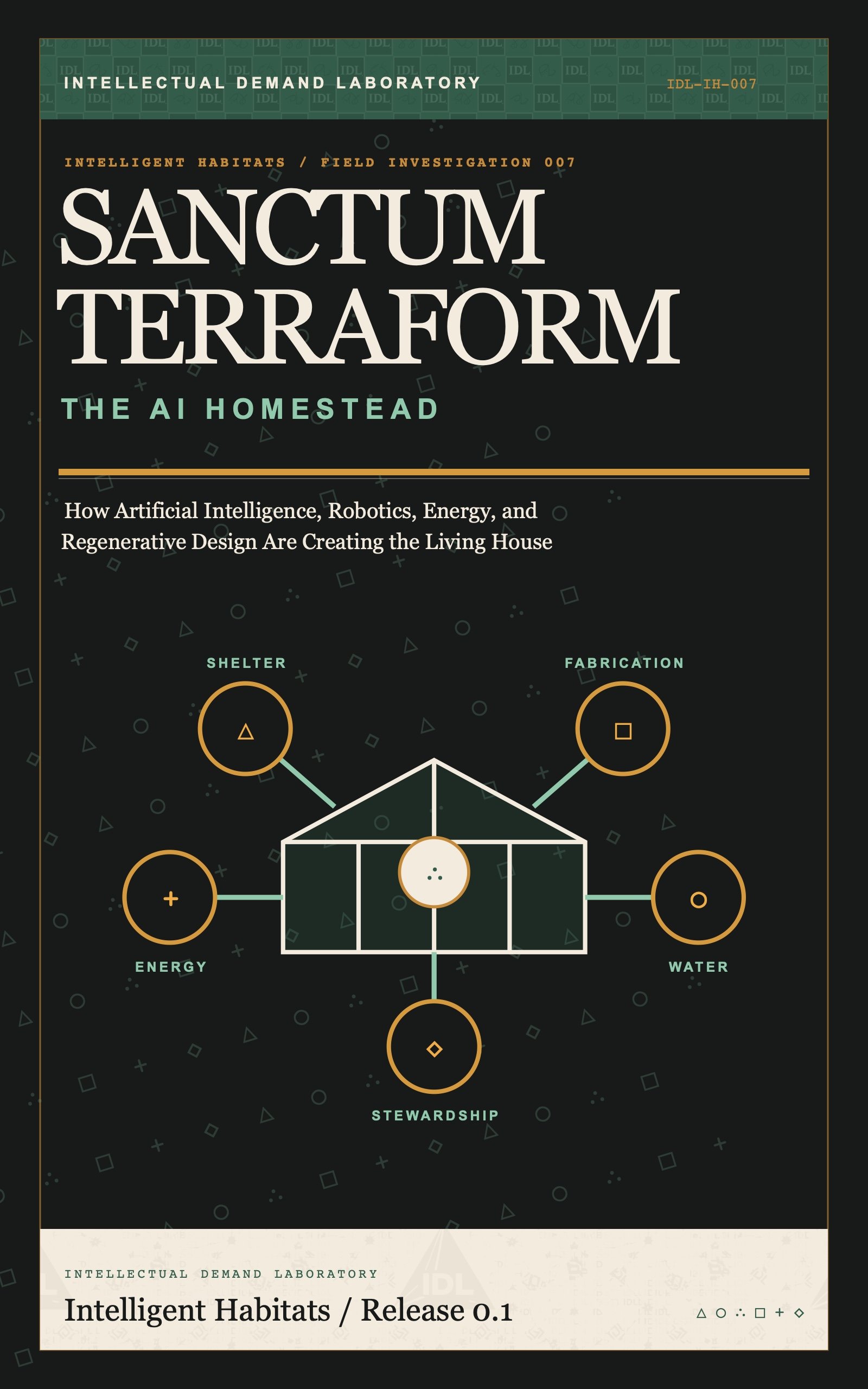
Cover of Sanctum Terraform: The AI Homestead, showing a living-house systems diagram connecting shelter, fabrication, energy, water, stewardship, and coordinating intelligence
Canonical cover · Release 0.1 · IDL-IH-007

PUBLICATION OBJECT / 007

Designer Academia field system

The investigation as a coordinated intellectual object

The cover establishes the first calibrated IDL commercial-cover chassis: institutional masthead, program line, dominant title architecture, explanatory proposition, inspectable system diagram, and release footer.

Program palette
Oxide Green · Verdigris · Signal Ochre
Symbolic lexicon
△ Shelter · ○ Water · ∴ Intelligence · □ Fabrication · + Energy · ◇ Stewardship
Document state
Canonical Release 0.1 production cover
Pre-order the Kindle edition on Amazon ↗

Central question

When does a smart home become an intelligent habitat?

The decisive change is not that the house contains more devices. It is that formerly separate domestic systems begin to perceive, model, and coordinate with one another.

A thermostat can optimize temperature. A battery can shift electricity through time. A soil sensor can report moisture. A rain barrel can preserve water. A garden robot can perform a narrow cultivation task. None of these artifacts alone constitutes an intelligent habitat.

The larger system appears when energy, water, shelter, food production, fabrication, maintenance, and human intention share enough information to cooperate—while remaining understandable, repairable, and subordinate to the people and living systems they serve.

Evidence boundary

Grid-responsive buildings, home energy management, distributed resources, environmental sensing, and agricultural automation already exist. Their convergence into a coherent domestic ecology remains an IDL synthesis and design hypothesis.

02 / SYSTEM MAP

Six layers of the intelligent habitat

The system is organized by function, not gadget category. Intelligence resides in relationships among layers.

01

Shelter

Envelope, thermal mass, ventilation, occupancy and comfort.

02

Energy

Generation, storage, flexible loads, vehicles and the grid.

03

Water

Capture, quality, storage, reuse, irrigation and discharge.

04

Cultivation

Soil, greenhouse, food forest, sensing and tending.

05

Fabrication

Workshop, tools, repair, local production and materials.

06

Stewardship

Human authority, goals, limits, judgment and care.

Design principle 01

Automation should increase the household’s capacity to understand and care for its systems—not make those systems illegible.

03 / DESIGNER ACADEMIA

Institutional doctrine

The Five Maxims

I

Knowledge deserves an authored environment.

II

Pattern establishes jurisdiction.

III

Density is permitted; hierarchy is mandatory.

IV

Stable mark establishes authority; unstable field establishes inquiry.

V

Intellectual seriousness and visual seduction are not opposites.

04 / ADJACENT INVESTIGATIONS

The surrounding lineage

IDL-IH-008

The Sensorium of Soil

How Sensors, Models, and AI Give the Earth a New VoiceProspectus stake →

IDL-IH-009

Machines That Tend Living Systems

The New Robotics of Care, Cultivation, and StewardshipProspectus stake →